Preserving assurance and compliance within Indonesia’s virtual currency ecosystem.

“Regulators today are in a learning curve and many of them, I would say, have insufficient knowledge and experience to actually look at how to regulate cryptocurrencies, particularly in exchanges”
Lon Wong, president of NEM
Preface
The value of cryptocurrency in recent years has been growing rapidly. As a college student with limited pocket money, I observe the wild motion of Bitcoin’s price has successfully attracted my colleagues and me to at least invest half of our savings. The popularity of Bitcoin (and cryptocurrency) in Indonesia is farther boosted by the increasing number of media coverage as the value of Bitcoin increases.
In comparison to more “conventional” investment platforms, such as the capital market, the growth of cryptocurrency’s investors almost overtook the number of stock market investors in Indonesia’s Stock Exchanges.[1] Less than a decade, cryptocurrency has managed to alter Indonesians perspective toward an asset class, despite expertise’s claims on cryptocurrency’s zero value.
The absence of regulations that specifically regulate cryptocurrency became the main foundation of Indonesia’s fast-growing cryptocurrency market. On the other hand, other countries have established their views both politically[2] and legally[3] on this particular financial technology. It is time for the Government of Indonesia to put more of their concern in the outgrowth wave of cryptocurrency in both national and global scale. The course can be concreted upon clear regulatory formulation, despite the political views seeing any potential benefit or loss behind the technology of cryptocurrency.
In this writing, as a cryptocurrency enthusiast myself (which by chance is also a law student) will curate:
- The general needs to be considered in cryptocurrency exchange (exchanges), both from positive and negative sides; and
- Government of Indonesia’s review of cryptocurrency, specifically exchanges, to date of writing. As for those, I hope to be able to address (even just a bit) questions that only Indonesia’s regulators can answer — “How Indonesia regulates cryptocurrency exchanges?”.
Stepping into “The Wild West” of Indonesia’s cryptocurrency market
“Virtual currencies (cryptocurrency) are not backed by any government or central bank, and at this point, consumers are stepping into the Wild West when they engage in the market”
Richard Cordray, Director of U.S. Consumer Financial Protection Bureau
The turmoil of “high-return-short-term investment” caused by cryptocurrency oft to be found in my daily life as a college student. Between breaks, many of my colleagues are busy monitoring their asset price mobility continuously, with the sweet expectation the price will go up and up. I am seeing the phenomenon myself how the profit seems to be very promising. However, the lack of knowledge about cryptocurrency and trading has the potential to inflict a financial loss.
December 2017 midst, one of the largest cryptocurrency Exchanges in Indonesia, Bitcoin.co.id[4] (now INDODAX) claimed to support the implementation of airdrop — free distribution of cryptocurrency to certain cryptocurrency holder — the NXT “digital asset”[5]. Airdrop NXT[6] will provide IGNIS to everyone who has NXT in their address (practically, an address can be assumed as a bank account).
Through the lens of common, the interesting offer is a drive for each individual to buy up in droves NXT in a huge amount until it has reached its peak in Rp35.800,00/NXT. The fact that the price was only influenced by the upcoming airdrop “event” cannot be ignored. Post airdrop practice, the price of NXT freefall to Rp7.500,00, with 70% price reduction.
At this point, I discover many of my colleagues experience major financial loss over the incident. Uniquely, I saw a lot of ugly airdrop NXT-IGNIS stories in such various social media thread. One of the most memorable is the story of a person bet “all in” his whole wedding saving in NXT asset before airdrop.
Cryptocurrency Exchanges in-between
Reflecting upon given narratives, the course was undeniably helped by the current cryptocurrency’s supportive ecosystem in Indonesia. The ecosystem is by means the role of parties whom capable to bring cryptocurrency market into existence in definite countries, in this case — Indonesia. In my humble opinion, the involved parties are as follows:
1. The people (re: “investor”);
2. Cryptocurrency Exchanges;
3. The government
Before proceeding, please note that within this scope, I will not discuss any Bitcoin and/or cryptocurrency startup ecosystem in detail as published by CoinDesk.
Here, I am not reviewing its classification as a startup, but rather to the parties in the base of cryptocurrency ecosystem in a country whereas existence affects the starting point of cryptocurrency market in related countries — specifically, Indonesia. It can be argued, if the parties above do not synergize with one another, then it has the potential to cut a big chunk of the cryptocurrency market.
For an example, if the Government of Indonesia prohibits the existence of Exchanges then the public will find it difficult to invest in cryptocurrency due to the limited access to exchange fiat money to cryptocurrency. Or when it comes to the case of ignorant Exchanges, which happen to neglect the regulation of the government, it would have potentially harmed the public (price manipulation is one of the most common found violation).[7]
A market for anyone, anytime
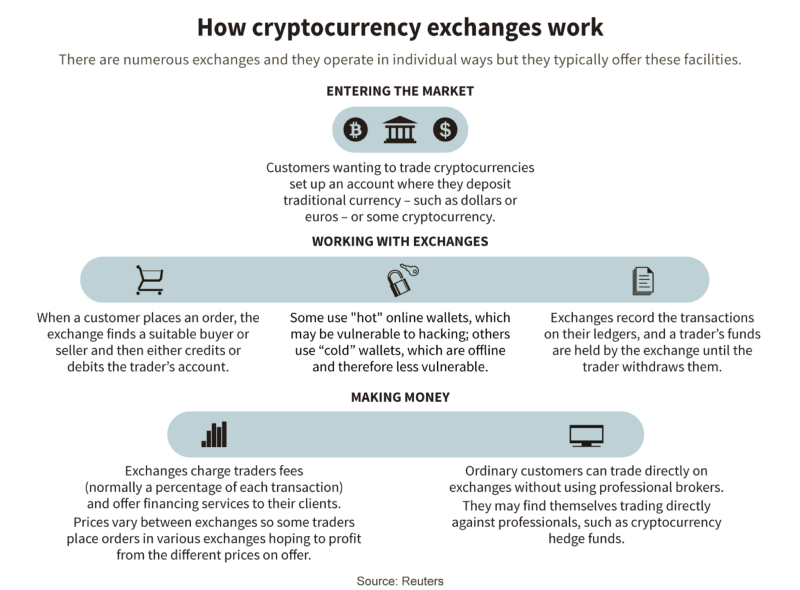
Back to the topic, in principle, in addition to the role of public and government as the regulator, Exchanges has a major influence to become a platform for the community to trade cryptocurrency directly using fiat money. I think this is the aspect to attract more Indonesians into the world of cryptocurrency investment, because to buy such asset with a potential for growth does not require hard steps (comparing to capital market investment), but only an identity photograph along with selfie then you can have cryptocurrency in one click.
In contrast to capital market, which requires administrative procedural series that must be met in advance for an investor to enter. This certainly makes it easier for new investors to enter in an Exchanges. Furthermore, to top-up Rupiah balance as ammunition to buy cryptocurrency, it can simply be done through bank transfer to the account of the Exchanges.
It is possible in the future that it is normal (if the government supports) if the amount of investors registered in Indonesia Crypto-Exchanges exceeds the number of investors registered in BEI.
Although the term “Exchanges” is literally interpreted as “place of exchange” — like in “forex money Exchanges”, a couple of Exchanges identify as “exchanges” for cryptocurrency trade. The market price of a cryptocurrency asset is determined by both buyers and sellers. Another difference with the BEI market mechanism that I find appealing is the absence of an upper-limit and under-limit (auto-rejection)[9] of a stock price movement in a day. In my opinion, it is also the case that underpins the prices of assets traded at Exchanges has a very unreasonable growth or decline.
Uniquely, the exchanges of Exchanges go live 24/7 nonstop. The continuity of Exchanges is not limited by time and place, as long as you have a qualified internet connection, then you can trade on the exchanges whenever you want.
The price to pay
Cryptocurrency traders are learning that where they buy and sell digital tokens can be just as risky as choosing a coin or picking a price.
Paul Vigna[10], author of The Age of Cryptocurrency: How Bitcoin and the Blockchain Are Challenging the Global Economic Order
A set of advantages of above Exchanges also comes with its disadvantages. Seeing the practice of Exchanges’ business in the past years, there are a couple of things that need to be noticed seriously — given the potential systemic impact in cryptocurrency market[11] if an Exchanges is large enough to produce it. As a new internet-based business model, it is not impossible to look after risks upon its technical and business model matters.
Here I will not discuss further technical issues — since my discipline is law, I will reflect on the potential risks of Exchanges from some past events supposing the public and government’s trust toward the particular business.
Hacking
Just like other Internet-based business model, cryptocurrency exchanges also vulnerable to cyber attack. Like a double-edged dagger, cryptocurrency, in addition, to give facilities to transact via the internet, but also provides the opportunity for hackers to steal it over the network. As for looking at the cases of hacked exchanges in lately has a sufficient amount of loss.
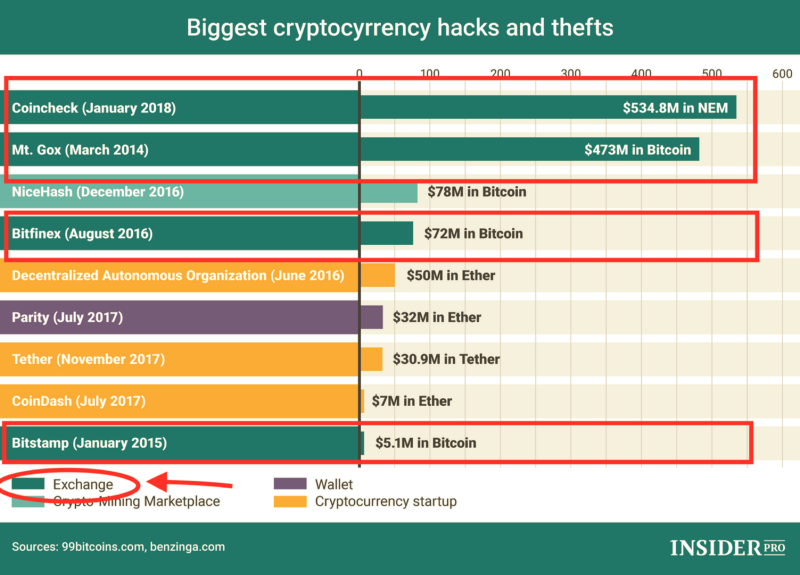
Reflecting on the exposure of the case above should be of concern to the public and the government. However, given the high profitability of rising cryptocurrency, is it worth it?
Talking about Indonesia — does not necessarily mean that I doubt the vulnerability of local exchanges security — it is obligatory for exchanges entities to sharpen their security system’s exchanges. In line with the effort to create a “fine” image of cryptocurrency in the eyes of public and government by the prospect of creating a friendly regulation for exchanges.
Price Manipulation
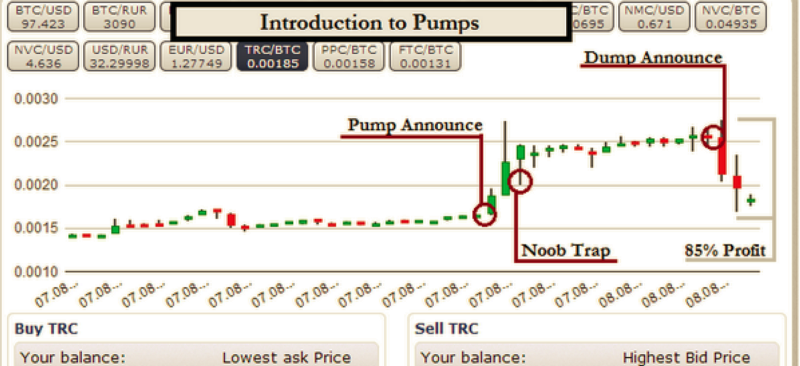
“Pump and Dump”, is a quite familiar term for cryptocurrency investors. Almost in every country, each has at least a community of pump and dump both small and large with one goal — manipulating the market price. The manipulation is created through a jointly executed purchase order, which is able to boost the price of a cryptocurrency in exchanges.
Figure obtained was no kidding, the rise of 50% to 100% is a very common phenomenon whereas “pump” is conducted. Ironically, not long after the price has experienced a high spike, the manipulators earlier also placed a purchase order up to the same volume altogether. The victims? Yes, of course, the cryptocurrency buyers at a price that already high. Blinded by the fast-paced price volatility certainly attracted newbie investors.
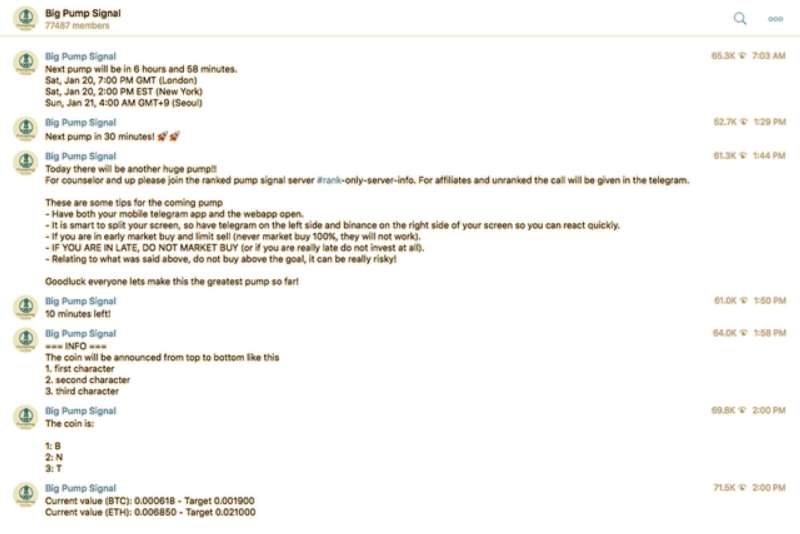
So far I see that it is still a rarity for exchanges to provide exposure to information regarding the practice of price manipulation. Even though the scheme is very detrimental for investors who are “manipulated”. In contrary to “pump”, where “dump” is conducted, the price drop is also irritating.
Suppose that you are an admin from a Pump and Dump Telegram’s group chat. You will announce a coin that will be pumped at 4pm to other members. Since you have first unpacked what coin to pump, you buy enough coins before 4pm. The probability of an upsurge cannot be denied, because eventually, your community members will buy the entire stock by the end of the day.

Unfortunately, the practice is considered normal in the world of cryptocurrency exchanges. It is rated as a part of the investment dynamics of cryptocurrency. Albeit legally speaking, there is no rule that is violated to gain profit in an unfair manner. There is the assumption that manipulation should be accepted as a part of exchanges continuity. In addition, Lon Wong, president of NEM, expressed that cryptocurrency price manipulation is ‘unavoidable’. Regulators must formulate a coherent regulation for exchanges.[14]
Insider trading
A registered new type of cryptocurrency in an exchange will absolutely boost the value of the cryptocurrency, moreover if it listed in large user-based exchanges. Like the IPO of a company in the stock market, if the company is considered to have good quality then investors will flock to buy it on the day the company is listed.
When exchanges decided to cut listing of a cryptocurrency type, ideally it should be kept as a secret to the public. Such information is also kept secret by exchanges. Then how about keeping the confidentiality of the information in the exchanges itself?
Can employees and directors of related exchanges purchase first before the cryptocurrency exchanges are registered? Yes. Is it illegal? No.
Reflecting on the case of Coinbase — one of the largest exchanges in the U.S — which in December 2017 listed Bitcoin Cash (BCH). Many users assumed the oddity of BCH price right prior to listing BCH in Coinbase. The internal employees of Coinbase were suspected of having purchased BCH in large volume earlier.
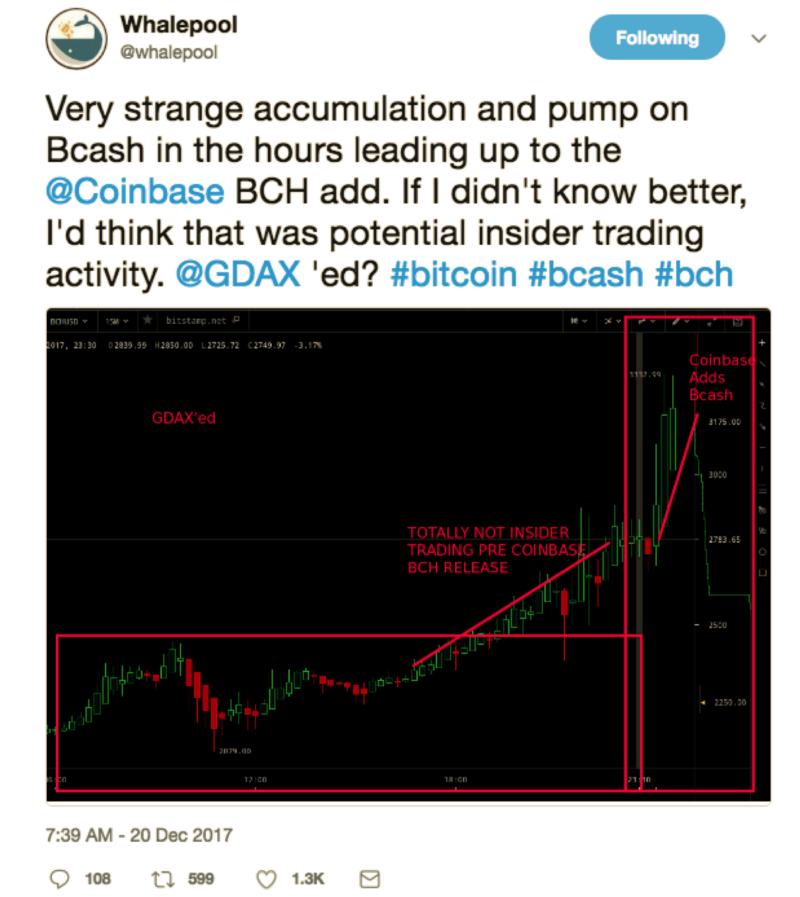
Nonetheless, in the end, if there is a regulation that specifically regulates insider trading in exchanges, it would be a hard work to prove such acts both technically and legally. Again to the business model exchanges, if many users evaluate the existence of insider trading, it will certainly affect user negative sentiments on exchanges.
Anonymity
The anonymity of cryptocurrency ownership opens doors for parties to do illegal acts, such as money laundering and terrorism funding. By far, large exchanges as a whole have enacted identity verification in advance to the transaction. Positively, the majority of these exchanges have enforced strict rules for registered users. Anonymous accounts have been widely acted upon in countries such as South Korea. The government of South Korea has dismissed all anonymous cryptocurrency users.
In Indonesia itself, INDODAX requires users to submit photo IDs along with selfie users with a piece of paper written on behalf of the user. In spite of efforts to minimize anonymity, it should be noted for regulators to implement Know Your Customer/Anti Money Laundering (KYC/AML) principles to every exchanges.
Other than explanatory above, there are still risks that I have not I mentioned due to the limited time of research. But principally, I think the issues addressed are quite representative for the introduction of gaps found in exchanges.
If you would like to find out more, see Bruce Kleinman’s[16] writings which briefly outline the risks of Exchanges. For more details, the research of Tyler Moore, et.al.[17] from the University of Tusla is relevant to elaborate further on the risks of Exchanges comprehensively.
Indonesia’s current views towards cryptocurrency
By far there is no single outlook to conclude Indonesia’s view toward the wave of cryptocurrency. Nevertheless, in recent months the government of Indonesia has shown its concern regarding cryptocurrency — including the underlying blockchain technology. This is stated by the institutions holding the ultimate financial policy patrons in Indonesia: the President, Bank Indonesia (Indonesia Central Bank), OJK (Indonesia Financial Authorities), and BAPPEBTI (Indonesia Commodity Futures Trading Supervisory Agency).
The President
“Like advanced robotics can take over the role of humans, as well as artificial intelligence, and virtual reality that continues to grow. Then blockchain and cryptocurrency — currencies without central banks are now being talked about by many,” — Joko Widodo, the President of Indonesia[18]
Quoting the above statement, it can be assumed that the existence of cryptocurrency and blockchain technology has received attention from the government. Departing from a statement of someone with a great legislative power in Indonesia’s trias politika, it cannot be denied that cryptocurrency exchanges have an important role in Indonesia’s cryptocurrency ecosystem which of course included in the agenda of regulators later on.
Financial Minister of Indonesia
“There has been no authority to regulate and observe, the virtual currency is prone to be used in an illegal transaction, money laundering, and terrorism funding. Besides, the unclearness of underlying asset which is the base of virtual currency value may trigger bubble risks that are not only going to inflict a financial loss to the public but to disrupt the stability of the financial system.” — Sri Mulyani, the Minister of Finance Indonesia[19]
Negative sentiments can be seen through the statement of Sri Mulyani. As a holder of macroeconomics control in Indonesia, this statement is certainly a serious issue. Furthermore, the agenda of policy formulation related to exchanges may concern macroeconomics perspective. However, can potential problems be mitigated through the formulation of appropriate policies? Given the component of ‘harming the public’ and ‘disturbing the stability of the financial system.
Bank Indonesia (Central Bank)
Bank Indonesia Regulation (Peraturan Bank Indonesia/PBI) 18/40/PBI/2016 Regarding the Implementation of Payment Transaction Process
Article 34
“The Payment System Service Provider is prohibited from conducting payment transaction process using virtual currency”
Elucidation of Article 34
“[Virtual currency] is a digital currency issued by a party other than the monetary authority obtained by way of mining, purchase or transfer of rewards such as Bitcoin, BlackCoin, Dash, Dogecoin, Litecoin, Namecoin, Nxt, Peercoin, Primecoin, Ripple, and Ven. Not included in the sense of virtual currency is electronic money.”
The above provision is the first form of government policy that concretely acknowledges the existence of cryptocurrency (virtual currency) according to Indonesian law. It can be assumed that the intent of the related BI regulation is to mitigate risks from cryptocurrency’s price fluctuation, which cannot be controlled by BI. This provision can be an indicator of how the government sees cryptocurrency technology. While it does make it easier for people to make payments, the risk of value fluctuations is difficult to mitigate due to the lack of controlling authority.
Bank Indonesia Regulation №19/12/PBI/2017 Regarding the Implementation of Financial Technology
Article 8 Paragraph (2)
“[…] The Financial Technology Operator is prohibited from conducting payment system activities using virtual currency.”
Elucidation of Article 8 Paragraph (2)
“[…] Prohibition to conduct payment system activities using virtual currency because virtual currency is not a legal means of payment in Indonesia.”
Seeing the progress of financial technology in Indonesia, in line with PBI №18/40/PBI/2016, this provision also attempts to mitigate risks from the use of cryptocurrency. As for Article 8 Paragraph (2), cryptocurrency is not a valid payment instrument. This is in conjunction with Law №7 of 2011 concerning Currency which stated the legal currency in Indonesia is Rupiah.
Press Release QnA №20/4/DKom on Virtual Currency
“As the payment system authority, Bank Indonesia prohibits all Payment System Service Providers (principals, switching organizers, clearing organizers, final settlement providers, issuers, acquirers, payment gateways, electronic wallet providers, fund transfer providers) and Financial Technology Operators in Indonesia both Bank and Non-Bank institutions to process payment transactions with virtual currency, as regulated in PBI 18/40/PBI/2016 on the Implementation of Financial Technology. Bank Indonesia as an authority in Monetary, Financial System Stability, and Payment System has always been committed to maintaining financial system stability, consumer protection, and preventing money laundering and terrorism funding practices.”
In this statement, BI confirms the basis of the argument for prohibiting the use of cryptocurrency: (1) financial system stability; (2) consumer protection; (3) money laundering practices; and (4) terrorism funding.
Looking at the negative side of exchanges, the above matters include the risks of exchanges. BI as a monetary policy controller has acknowledged the associated risks.
Seeing the development of exchanges (along with cryptocurrency) in Indonesia’s future, if there is any indication of the fulfillment of these risks, Indonesian regulators will absolutely provide a more enforced and detailed arrangement of local exchanges.
BI’s Officials Statement(s)
“Ownership of virtual currency is very risky and full of speculation because there is no authority responsible,there is no official administrator, there is no underlying asset underlying virtual currency price and trading value is very volatile so vulnerable to the risk bubble and prone to be used as a means of washing money and financing of terrorism, so that it can affect the stability of the financial system and harm the public. Therefore, Bank Indonesia warns all parties not to sell, buy or trade virtual currency”
— Agus Martowardojo, BI Governor 2013–2018
“Today it can go up, and tomorrow it can go down — just like the roller-coaster ride. If it comes up today you will be happy, if it comes down tomorrow you will be crying. There is no consumer protection here, there is no regulating authority, we are not responsible if anything happens because we do not acknowledge”[20]
— Eni V Panggabean, Executive Director of Payment System Policy Department
The statements from both BI officials indicates bearish sentiment towards cryptocurrency. Although the sentiment towards the exchanges has not been seen from the policy of BI, the formulated ones to the date have greatly discredited the existence of exchanges in Indonesia. In near future, if the exchanges do not show good intentions in mitigating the risks mentioned, full restrictions has the full potentiality to become an option for BI to respond exchanges.
BAPPEBTI (Commodity and Futures Trading Supervising Body)
“Currently, the Head of Bappebti has signed a decision to make cryptocurrency as a commodity worth of trading on the exchange. It has been done two days ago, I do not know the number of its Decree yet,” said Dharma Yoga the Chief of Market Supervision and Development Bureau to Kontan.co.id (31/5).[21]
A few days ago marks fresh breeze for cryptocurrency regulation in Indonesia. After the discourse statement of the study of cryptocurrency as a previous commodity, Bappebti finally decided to make it a commodity worth to be traded in the stock. In this headline, the thing that would have a major effect on exchange regulation would be the establishment of cryptocurrency as a commodity.
Referring to the provisions of Article 1 Sub-Article 2 of Law №10 Year 2011, the “Commodity” is by means “All goods, services, rights and other interests, and any derivatives of commodities, which may be traded and subjected to Futures Contracts, Syariah Derivative Contracts, and/or any other Derivative Contract.”
If the question arises on why cryptocurrency can be considered as “rights” in Indonesia? First, it is based on the foundation of Indonesian law that uses civil law as its legal system, by that, the provision related to civility is determined by the Civil Code. Second, objects in the Civil Code are stipulated in Article 499 which states that “[…] material is every item and every right that can be controlled by property rights.” Third, technically the nature of cryptocurrency has fulfilled the element “can be controlled by property rights”. I will not discuss further upon this matter, yet so far the analysis is taken from my colleague, Rahma Diasti upon her thesis about cryptocurrency through the juridical point of Indonesian law.
Back to the preliminary review of its relevance to exchanges, regarding the regulation, it can be used as a reference for exchanges arrangement whereas in the company there will be “rights” to be traded. The formulation of a firm regulation will provide clear legal relations between buyers and sellers, unlike as if buying virtual goods has real values or not.
OJK (Financial Services Authority)
“After establishing crypto as a commodity subject traded on the futures exchange, according to Yoga, Bappebti will make further regulation on a crypto stipulation as a commodity, such as exchanges, wallets, and mining companies. This further regulation will involve various ministries and institutions such as Bank Indonesia (BI) and the Financial Services Authority (OJK).”[22]
In the same article, OJK is also referred as one of the institutions involved in establishing regulations for exchangers. However, looking at the direction of OJK that has begun to explore the world of financial technology, I think OJK find an important role in the formulation of regulation for exchanges later.
The Urgency
Why a regulation for crypto-exchanges is needed?
So far the Government of Indonesia has shown its attention towards exchanges arrangement. But if the formation takes too long it only leads to above risks haunting both the public and the Indonesian government. Here are things that I think should be considered as principal consideration by the regulator to immediately set following arrangement for exchanges.
Other countries against exchanges (the U.S and Japan)
The U.S.
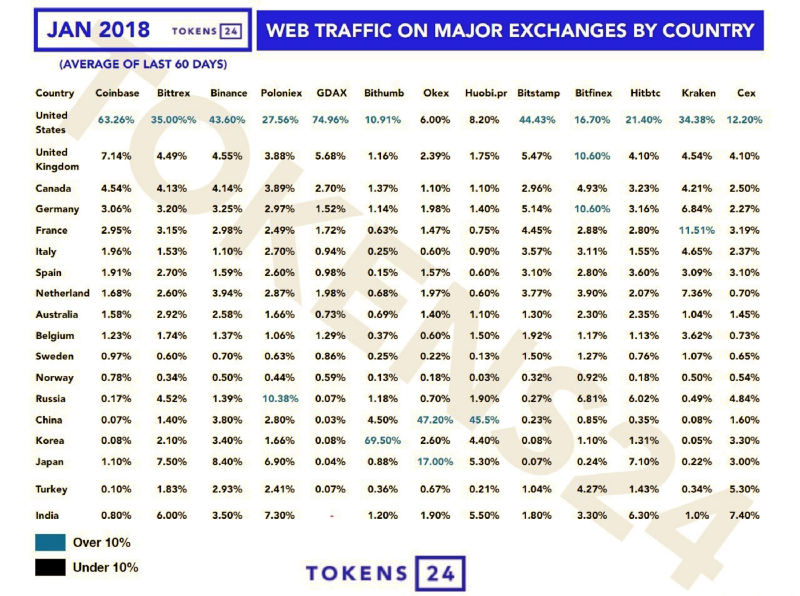
From the table above, the U.S placed first with the most traffic in exchanges websites. Seeing the phenomenon, I consider the U.S government being quite responsive in calling for the development of cryptocurrency (along with exchanges). First, 3 years ago the U.S. government through Commodity Futures Trading Commission (CFTC), has recognized cryptocurrency as a commodity.[24] Next, on March 7, 2018 ago, the Securities Exchange and Commission (SEC) — the U.S. government agency that oversees securities transactions, activities of financial professionals and mutual funds trading to prevent fraud and intentional deception — issued a public statement regarding exchanges.[25]
“A platform that trades securities and operates as an “exchange” as defined by the federal securities laws, must register as a national securities exchange or operate under an exemption from registration, such as the exemption provided for ATSs under SEC Regulation ATS.” — SEC
The SEC affirms that any exchanges established in the United States must be registered. The purpose is to prevent fraud and manipulative practices. The SEC also adds that although there are “trading platforms” (re: exchanges) that do not meet the definition of “exchange” under the law of the U.S., the trading platform remains committed to offering “digital assets” of “securities”.
Seeing the response of the U.S government, indeed the formulation of policies is not specifically designed for exchanges. The U.S. government reviews from existing regulations then expanded its interpretation with elements of exchanges and cryptocurrency which are new to the community.
In this case, it is necessary to remember that the U.S legal system is different from Indonesia — which adapts the common law system. After all, even if there is no regulation in detail governing exchanges, if disputes and criminal acts occur within the scope of exchanges, law enforcement has the flexibility to penetrate the law.
Japan
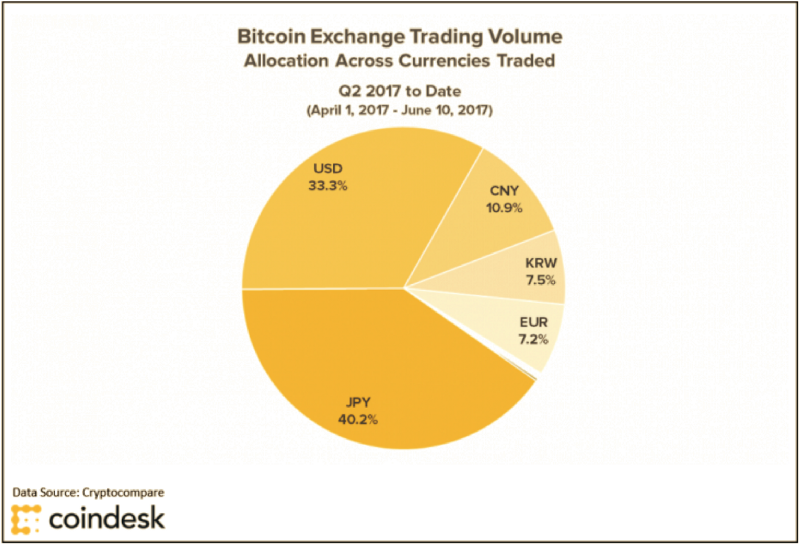
So far Japan has given a positive signal for the imposition of cryptocurrency in the country. Through revised Payment Service Act in April 2017, Japan defined a “virtual currency” (cryptocurrency) as a form of payment. Japan does not recognize cryptocurrency as a legitimate means of payment, but it legalizes its use to purchase goods.[27]
In regards to exchanges, Japan provides conditions for exchanges to be registered with the Financial Service Agency (FSA). These requirements are related to sharing ownership, propriety to the Payment Service Act, and related important points that must be met in the exchanges management system[28] (which is worth to copy for Indonesia).
Even if Japan is known as “paradise” for crypto activists through the above regulation, criminal acts are still unavoidable. Proven by the case of NEM coin theft with the amount of loss reaching 530 million USD at CoinCheck at the end of January 2018. Departed from the particular case, FSA has initiated a direct inspection of all exchanges to see if there is still continuing security gap in the warning for the other 7 exchanges.[29]
Learning from Japan, it looks like exchanges regulation is not an easy thing. Given this business that has the variety of risks that must be mitigated. The Indonesian government should learn from the experience of Japan on exchanges regulation.
The increasing number of Exchangers in Indonesia
Although the volume of cryptocurrency transactions in Indonesia has not been significantly improved compared to other countries, over time, it is most likely there will be future problems for local cryptocurrency ecosystems. The presence of exchanges both local and foreign will certainly continue to spread into Indonesia if the interest of the people of Indonesia continues to grow.
One of the foreign exchanges that have stated to expand the scope of its business to Indonesia is Coinone Indonesia (www.coinone.co.id)[30]. Coinone is an exchanges from South Korea and claimed to be among the top 10 exchanges worldwide. I think the entry of Coinone to Indonesia will not close the possibility for other foreign exchange to participate in Indonesia’s cryptocurrency market, along with the old players consists of Indodax[31], Luno[32], Triv[33], TokoCrypto[34], etc.
In addition, at least the Government of Indonesia took preventive actions, especially in terms of consumer protection.[35]
Considering Indonesia as “Asia’s Next Blockchain Hub”,
I am seeing a lot of the term expressed by Forbes media in articles about crypto for Indonesia. Followings are some interesting points that I get from the articles,
First, a statement of Siddharth Sthalekar — CEO of Sacred Capital, the firm that evaluates blockchain companies and ICO, that says “Indonesia is a region that is ready to lift blockchain technology.”[36]
Second, a statement from Pandu Sastrowardoyo — Co-Founder of Blockchain Zoo, “There has been an amazing explosion of interest in the past 18 months, initially driven by the cryptocurrency sector, but morphing into an interest in actual tech applications recently”.
The articles of Forbes that I found seem to be “bullish” towards the blockchain industry in Indonesia. With the frill of “Asia’s Next Blockchain Hub” it adds to see if Indonesia is ready to face this technology. The regulation formulation on exchanges is also one of the vital steps that must be completed first by the Government of Indonesia to create a healthy blockchain ecosystem in Indonesia’s future.
Indonesia with Muslim as Majority
There is still no decisions or notably “fatwa” by Majelis Ulama Indonesia (MUI) that could be used as a foundation for the consideration of the legality of cryptocurrency exchanges. But previously, MUI has noticed a few things related to cryptocurrency.[37]
From this point, the perspective of Islamic jurists in Indonesia with muslim as majority has at least an influence on the formulation of arrangements toward cryptocurrency exchange. Whether positive or negative, until now it is still uncertain.
Conclusion
Up until now, Indonesia towards cryptocurrency (and blockchain) is still on the gray area, because it is difficult to determine the interest of the regulator toward exchanges. However, it can be concluded that the implementation of regulation of Indonesian exchanges still awaits for the results from the current regulators, similar to most other state regulators, using the method of ‘Wait and See’.
In my perspective, there are many considerations in cryptocurrency exchanges from the impacts of both positive and negative. As more investors entering the Exchanges, it is becoming a regulatory obligation in Indonesia to immediately formulate the regulation, both preventive and repressive, that is compatible with Indonesian legal politics.
It should be underlined, that the legalization of Exchanges is one of the “VIP tickets” (in honor of “VIP Bitcoin Indonesia” 2014–2018) for the beginning of cryptocurrency development in Indonesia. Seeing the progress and the potentiality of crypto/blockchain technology globally in recent and future (despite many parties labeled it as a hype alone), Indonesia must choose its steps carefully.
Hopefully, the regulators would not be “distracted” since they are being too slow in adapting the growth of existing technology and to design the appropriate regulations. Prior to the fact that the current Indonesian regulators only pay serious attention to technology issues if they found a problem that is quite massive.
Reflecting from GoJek — Indonesia’s #1 local ride-hailing app — which previously had been buffeted by legal vacuum until the urgency to formulate ideal regulations for drivers finally arose. The high demand of the public also contributed big time. It is for an absolute reason that we do not want a similar case to be found in cryptocurrency exchanges, given the urgency to mitigate risk behind the nature of the business model.
References:
[1] https://www.newsbtc.com/2018/03/14/indonesias-largest-crypto-exchange-indodax-overtake-countrys-stock-exchange/
[2] https://www.sec.gov/news/public-statement/statement-clayton-2017-12-11
[3] http://www.pbc.gov.cn/goutongjiaoliu/113456/113469/3374222/index.html
[6] https://www.jelurida.com/ignis-airdrop
[7] https://www.sciencedirect.com/science/article/pii/S0304393217301666
[8] https://www.reuters.com/investigates/special-report/bitcoin-exchanges-risks/
[9] http://www.bareksa.com/en/text/2016/12/14/aturan-baru-auto-rejection-bursa-berlaku-3-januari-2017/14460/news
[10] https://www.wsj.com/articles/crypto-investing-comes-with-a-big-risk-the-exchanges-1520078400
[11] https://hackernoon.com/do-exchanges-pose-a-systemic-risk-85af921ea6c9
[12] https://news.bitcoin.com/cryptocurrency-market-manipulation-is-rife-but-does-anyone-care/
[13] https://theoutline.com/post/3074/inside-the-group-chats-where-people-pump-and-dump-cryptocurrency?zd=1&zi=vrkxd5w2
[14] https://www.cnbc.com/2018/02/13/cryptocurrency-price-manipulation-is-unavoidable-nem-president-says.html
[15] https://www.theverge.com/2017/12/20/16800940/coinbase-bitcoin-cash-fork-insider-trading-probe
[16] https://hackernoon.com/do-exchanges-pose-a-systemic-risk-85af921ea6c9
[17] https://tylermoore.utulsa.edu/toit17.pdf
[18] https://finance.detik.com/moneter/d-3846677/jokowi-buka-suara-soal-peredaran-bitcoin-apa-katanya
[19] https://katadata.co.id/berita/2018/01/23/ojk-tak-bisa-larang-penyelenggara-perdagangan-bitcoin-nonkeuangan
[20] https://finance.detik.com/moneter/d-3783223/ceo-bitcoin-ri-respons-pernyataan-bi-hingga-mui-ini-katanya
[21] http://investasi.kontan.co.id/news/bappebti-resmi-tetapkan-uang-kripto-sebagai-subjek-perdagangan-berjangka
[22] http://investasi.kontan.co.id/news/bappebti-resmi-tetapkan-uang-kripto-sebagai-subjek-perdagangan-berjangka
[23] https://www.tokens24.com/exclusive/crypto-exchanges-insights-report-2018
[24] https://www.cnbc.com/2015/09/18/bitcoin-now-classed-as-a-commodity-in-the-us.html
[25] https://www.sec.gov/news/public-statement/enforcement-tm-statement-potentially-unlawful-online-platforms-trading
[26] https://www.coindesk.com/3-reasons-the-global-cryptocurrency-exchange-market-is-maturing/
[27] https://bitflyer.com/en-jp/virtual-currency-act
[28] https://www.fsa.go.jp/en/news/2017/20170930-1/02.pdf
[29] https://bitcoinmagazine.com/articles/japan-toughens-oversight-penalizes-cryptocurrency-exchanges/
[30] https://news.bitcoin.com/major-korean-exchange-launches-indonesia-cryptocurrencies/
[32] https://www.luno.com/id/exchange
[33] https://triv.co.id/id/home/bitcoin
[35] https://files.consumerfinance.gov/f/201408_cfpb_consumer-advisory_virtual-currencies.pdf
[36] https://www.forbes.com/sites/lamsharon/2017/11/01/indonesia-is-ripe-for-cryptocurrency-disruption-could-it-be-asias-next-bitcoin-hub/#5434c2c87309
[37] https://finance.detik.com/moneter/d-3782461/mui-imbau-umat-islam-hati-hati-dengan-bitcoin

 Araya Anggara Putra's Blog